Spartans cruise academic skies by coding drones in computer science class
December 12, 2025
East High School students like Calvin, Owen and Ryan turned their coding knowledge into aerial adventures during a Computer Science Week lesson in early December.
Computer Science Foundations students learned how to program drones to accomplish specific tasks with block coding software. They instructed their drones to take off, move through the air and land on circular paper targets on a cafeteria table. The drones had to land on all three targets that were arranged in a triangular shape in the lunchroom.
Owen and Ryan said they were excited to try the activity for the first time. The ninth graders said they liked seeing their coding work come to life in the form of soaring drones.
“I think it’s kind of cool to see how your code actually can do things in the real world instead of just on a screen,” Owen said. “It’s fun to see your progress in real time.”
“I enjoy it because I think coding’s just kind of cool and a neat thing to do,” Ryan said. “Being able to do it with something that moves and not just on a computer program or a Chromebook is interesting.”

East math teacher Peter McGinley said he was pleased with the way the Spartans approached the assignment. He said these types of lessons were important because of the growth in computer science and technology industries. Drones are now being utilized in various career fields, ranging from agriculture to marine biology.
“We have a lot of kids taking it at East, but I think we should have everybody taking computer science in some form because of the logical reasoning behind it,” McGinley said. “It kind of shows why things work and how things work, and it’s something you’re going to see more and more in the everyday world.”

McGinley taught the Spartans how to use a block coding program called “Blockly” prior to the activity. It was one of the first times students used block coding in the Computer Science Foundations class. Much of their work this semester has been with a script-based coding program called Python.
Students started their code with a ‘run’ button. They created a ‘takeoff’ command that lifted the drone from its resting place on a table, and they then included an ‘up’ command that told the drone to rise above cafeteria tables that were between the starting point and the three targets. They completed the first part of the coding process by instructing the drone to move forward in the air before landing on the target.
After reaching the first piece of paper, the Spartans had to program their drone to turn 90 degrees in the air and land on the second target. Their goal was to then successfully return to their home base.


McGinley said learning how to solve problems through a trial-and-error method was a key lesson for the class. If drones came too close to each other, the resulting changes in airflow caused some of the devices to be pushed off their original path. Two students had to unexpectedly change their drone’s batteries midway through the activity, and others had to alter their code to accommodate for greater distances between the first and second targets.
“You would see them have some success after a little bit of trial and error,” McGinley said. “I think it’s important to show them that it’s not always going to work out the way they want to. It’s hopefully something that they can apply to other classes that they take.”
Owen said he enjoyed testing potential solutions for each of the puzzles. He, Calvin and Ryan adjusted their code during the afternoon to bring their drone closer to the right landing spot.
“Sometimes it was a little too far to the side of the target, but over time, we got it closer,” Owen said.

The Spartans also learned how to incorporate new strategies into their answers. McGinley moved around the cafeteria and offered advice to the groups when needed. Their excitement level soared when they watched the promising results of the updated drone flights.
“Mr. McGinley came over and helped us by telling us that if we used this command, it would help it go up further and it would help it not be attracted to other things,” Calvin said. “It just made it better.”
Owen said the Computer Science Foundations class has been a good extension of the earlier exposure he has had to coding and programming. LPS students begin learning how to code in elementary school, and they take computer science courses in both middle and high school.
“I enjoy being able to learn to code because I feel that’s something becoming a lot more prevalent today,” Owen said. “It’s a useful skill.”
“I’m kind of amazed at how developed my students are with their coding skills when they get here,” McGinley said. “I think that kind of allows us to raise our expectations, so I think it’s a great idea to get them started young.”
McGinley said he would encourage people of all ages to enter the world of coding.
“Anybody can be successful in coding,” McGinley said. “Even people who wouldn’t think that they would normally be good at coding, just give it a try, because I think it’s a great path to pursue.”
LPS students explore computer science topics in many classes and school organizations. Visit home.lps.org/cte/cs to discover more information about our computer science curriculum.
Do you have a story idea? Share it with the LPS Communications Team by filling out this form!
Published: December 12, 2025, Updated: December 12, 2025
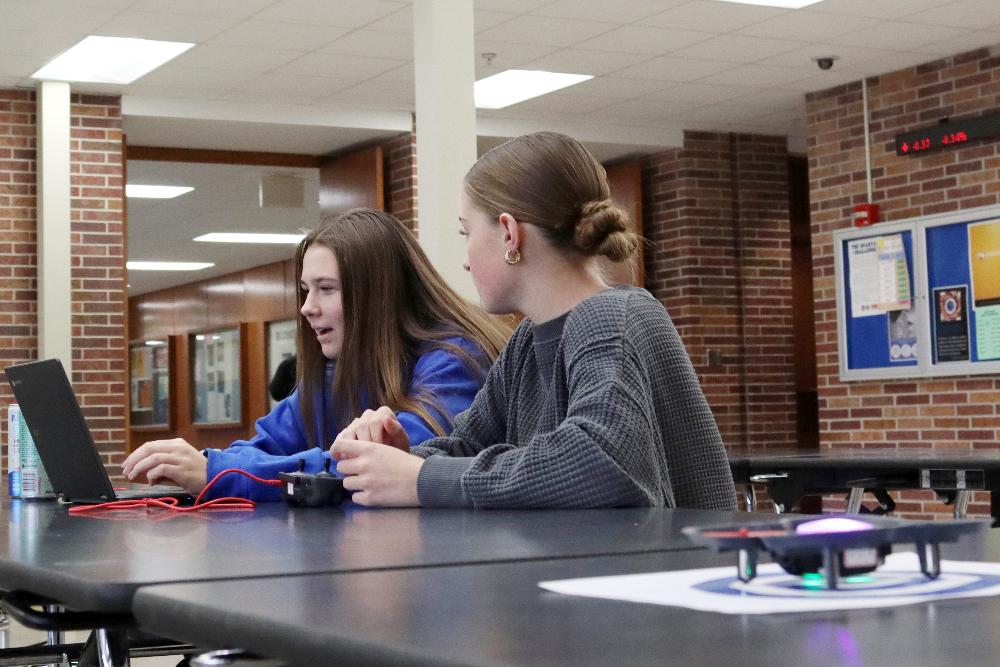
East High School students prepare to launch their drone in a Computer Science Foundations class. The Spartans programmed their drones to take off from a cafeteria tabletop, fly across the room and land on a circular paper target.
