LPS Library Services project brings historical yearbooks to digital world
December 23, 2025
People living in Auckland, Amsterdam or Ainsworth can now access thousands of Lincoln Public Schools yearbook pages thanks to the efforts of LPS Library Services.
Chris Haeffner and Sara Scott are leading a project that is opening a world of archived LPS information to the general public. Haeffner, the LPS director of library services, and Scott, the LPS cataloger and archivist, have created digitized copies of yearbooks from six high schools and 13 middle schools. Their perseverance is allowing alumni, family members and current students to scroll through historical gems from the comfort of their favorite couches.
Scott and Haeffner began the yearbook project in 2023 and have unveiled their work under the yearbooks tab on the LPS Library Services website. They and high school technicians Logan and Mikah have used an Indus BookScanner 9000 machine to upload nearly every pre-2020 publication to the website. Some of the earliest copies include the 1917 Lincoln High, 1926 Whittier Junior High and 1928 Irving Junior High issues.
“We’ve found that people are incredibly interested in finding information not only about themselves, but about their grandparents and family members and anything related to genealogy,” Haeffner said. “We’ve had a ton of alumni who are very, very excited about and interested in what we’re putting out publicly for them.”
“It’s a really good feeling,” Scott said. “We want people to be able to see their history, and it’s so cool to know that it goes even beyond the city limits. There’s a far reach for this that I don’t think we could have necessarily predicted.”


Alexis Scargill represents Nebraska on the Midwest Archives Conference, which is a group that supports archivists, curators and information professionals from 13 states. She said the LPS digitization project is important in numerous ways.
“Digitization dramatically expands access while reducing physical handling of original materials,” Scargill said. “Yearbooks are heavily circulated items, and digitizing them helps preserve the originals while allowing for circulation online. This opens the yearbook up to students, alumni, families and researchers, regardless of their location.”
The yearbook project is the first part of a massive digital archiving endeavor that will eventually catalog every historical item at LPS. Scargill said Scott and Haeffner are doing a good job of putting the acronym LOCKSS – Lots of Copies Keeps Stuff Safe – into action. She said having multiple ways to access one-of-a-kind sources like yearbooks, documents and pamphlets is crucial in case of disasters or deterioration.
LPS experienced this situation in 2011 when the district administration building burned to the ground. Many materials survived the blaze, but the memory of the fire lives on in a special archives room in the current Steve Joel District Leadership Center. Scott and Haeffner can still smell smoke on some items that are now housed in file cabinets.
“Knowing that we’ve had a fire in the past made this even more important, because we didn’t have an inventory of items to know what was missing then,” Scott said. “We didn’t have an online catalog to be able to refer back to and know that this book was once 146 pages and we lost 50 in the fire. There wasn’t anything to refer back to, so we wanted to do this right, because we need to protect ourselves and those items. We need to know what we have.”


Scargill said Scott’s expertise allows LPS to retrieve and understand information in a thoughtful way. For example, all of the yearbook scans include optical character recognition (OCR) information. The OCR metadata makes it possible for people to search each yearbook for specific names, events or activities they might be interested in.
“Files must be managed, formats monitored and systems migrated and maintained over time,” Scargill said. “Having an archivist leading the way ensures that none of these digitization efforts are wasted and the materials are accessible well into the future.”
Haeffner said the yearbook project has strengthened the connection between LPS Library Services and the community. She said that could allow more historical items to come to light.
“Where we do have a missing book or two, someone might be looking online and say, ‘Hey, mine’s not there, but I have a copy,’” Haeffner said. “We’re hopeful some of the missing yearbooks might show up in that way.”
Scott and Haeffner cannot digitize a yearbook until every student pictured in it has graduated from high school. This creates a lag time of five years for high school, eight years for middle school and 12 years for elementary school books to appear on the website.
Scott is preparing to begin scanning available elementary yearbooks in the near future. She is also starting to digitize 3-D items such as athletic and fine arts trophies. LPS Multimedia Content and Broadcast Technicians David Koehn and Brian Seifferlein created a platform to capture images of these artifacts. Those will be housed on the Library Services website once that long-term project is completed.
Scott said it has been meaningful to digitize yearbooks for the public. She said it is fun to know that everyone living from A Street to Australia can answer questions because of the LPS archival work.
“You want to correctly document these items,” Scott said. “There are people who really care about these things. If we’re going to keep our history alive, we have to know these things and write these things down, because otherwise it’s gone.”
LPS Library Services provides many educational resources for students, families and the community. View home.lps.org/libraries to look at library lessons, eBook backpacks, educational videos and other helpful items.
Do you have a story idea? Share it with the LPS Communications Team by filling out this form!

Published: December 23, 2025, Updated: December 23, 2025
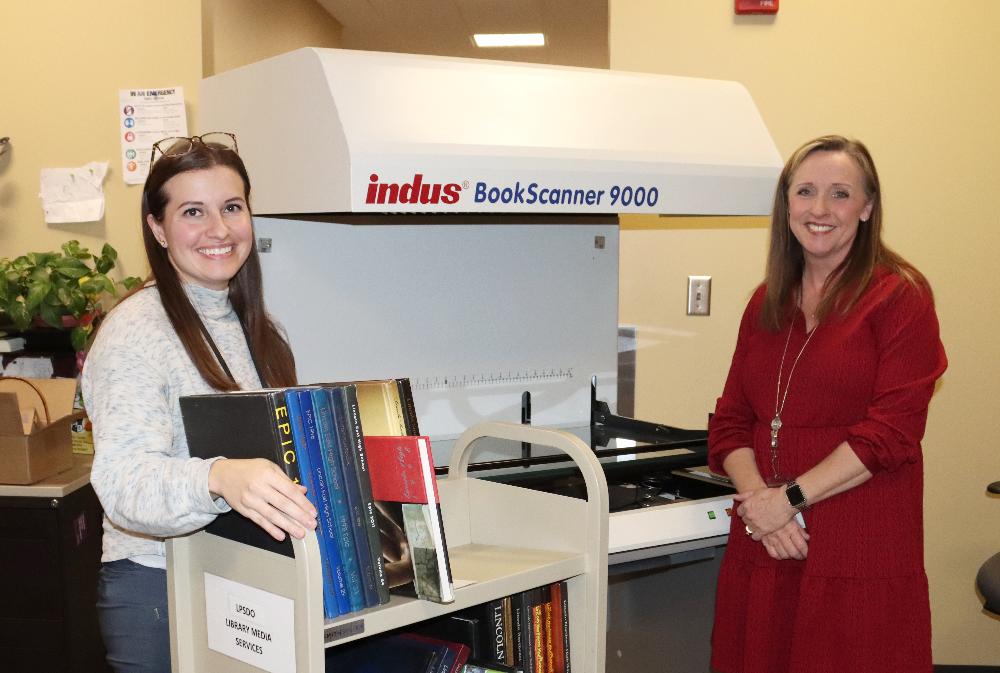
From left, Sara Scott and Chris Haeffner smile next to an Indus BookScanner 9000 machine at the Steve Joel District Leadership Center. Scott and Haeffner have led a yearbook digitization project that is providing a valuable resource to the community. Thousands of scanned yearbook pages are now available to the public at the LPS Library Services webpage.
